Home Enquiry Form Quotation Request Forms Brochure Request Form What's New Product Lists Product User Manuals Product Technical Notes Ultrasound Equipment Ultrasound Transducers Pre-Plugged Seed Needles Seeding/Biopsy Steppers Disposable Grids Disposable Drapes Endocavity Balloons Grid Adapters PAL Pro Stirrups OR Tables / Trolleys Source Measurement Electrometers Equipment Services Suggestions FAQ Search Useful Web Sites Training Courses Calibrations and Upgrades Intravascular Brachy LDR Calibrations Prostate Brachytherapy Prostate Biopsy 3D Prostate Mapping Prostate Cancer Prostate Seed Implant Mammography/Diagnostics Site Map External Beam/IMRT/CT Exradin Ion Chambers Prostate Scanning SeeDs and Strands Seed Implant Dosimetry HDR/PDR Dose Planning HDR MultiSource HDR Gynae Applicators HDR Gynae Template LDR/MDR Curietron HDR IU Sleeves HDR/IORT HAM Applicators HDR/IORT Breast Applicator HDR Prostate Brachy HDR Prostate Template AUTIMO Beam Systems Alloys and Alloy Melters Slideshow Bibliography Our Company Curietron Appeal Iridium-192 Wire Sources Eye Applicators Gold Fiduciary Markers Urology Biopsy Biopsy Guns/Needles Needles/Guns/Applications Clinical Oncology Needles Haematology Biopsy Interventional Radiology Urology Needles/Guns Breast Biopsy/Localisation Gynae Biopsy / Aspiration Skin Biopsy Punch Anaesthesia Needles Antenatal Diagnostic Needle Guides Syringe Holders Biopsy Grids Biopsy Steppers Infection Control-MultiMAT Bone Marrow Biopsy Vertebroplasty Laparoscopy Needles Laparoscopy Support Temno Adjustable Coaxial MRI Biopsy/Localisation Percutaneous Injection-PIA Support/Position Arm
 

 Dose Planning Equipment
Home
Up
Prostate Seeding Needles
Pre-Plugged Seed Needles
Stabilisation Needles
Hawkins Blunt Needle
Sterile Pre-Cut Spacers
Seed Handling
Source Measurement
Seed/Needle Cradle
Dose Planning Equipment
O R Equipment


Dose Planning Equipment - Treatment Planning Systems

Three Systems available:

1. PSID 4.5 ( NEW )- Upgrades available

2. VariSeed 8.5

3. Interplant

 PSID 4.5 Brachytherapy Software

Cancer of the prostate is one of the most frequent cancer types of males. As standard treatment the prostatectomy, i.e. the surgical removal of the prostate, is performed in most cases. Besides the general operating risk a considerable high risk of post-operative incontinence and impotence exists.

A prostate cancer therapy with significantly reduced side effects and surgical risk is represented by the interstitial LDR- (low dose rate) brachytherapy of the prostate. Brachytherapy is the implantation of small, weak radio-active radiation sources (so-called seeds) directly into the prostate gland. As these seeds are only about 0.5 mm in diameter, the implantation is performed with injection needles.

The seeds develop their effect directly in the cancerous tissue, only a small dose burden is exposed to adjacent organs. In long term studies the healing rate was found to be comparable to the surgical removal of the prostate. About 40,000 cases of prostate cancer per year are treated recently in the USA by the implantation of seeds.

The brachytherapy treatment planning software PSID (permanent seed implant dosimetry) for ultrasound guided radiation therapy of prostate cancer is one of the recent development activities. The use of advanced 3D visualization techniques allows an overview of the planning results at unsurpassed speed and flexibility.

PSID - Brachytherapy Planning Screen Shot
Just load the appropriate ultrasound images into the program, draw in the respective organ contours and let PSID automatically calculate the optimal positions of the seeds. Alternatively you may position the seeds manually or use a combination of both automatic and manual seed placement. Isodose lines are displayed immediately.

PSID will automatically calculate the dose volume histogram, the differential dose distribution, the needle loading plan and all the data you may need additionally.

Exact dosimetry even with different seed types
Based on the organ contours PSID will calculate 3D views from any desired viewing angle. The organ structures may be turned in any direction. Click on or off the organs to be displayed. Choose whether the seeds and / or needles should also be displayed. Naturally, selected isodose surfaces will be displayed in 3D as well, if desired.

Slice the 3D structures in any direction to see where the seeds are located, for example. Choose the transparency / opacity of each organs you look right through the surface and see what is behind. The 3D colour-coded surface dose feature allows easy detection of hot spots at organ surfaces.

Postplanning using DICOM images in 2D mode
The needle loading plan is the essential for seed placement. The plan describes how to load the needles with seeds, where to position the needles and how deep the needles are to be inserted into the prostate. If it is desired to place the seeds at intermediate positions this will also be displayed.

Strands as well as individual seeds may be used. Auto placement supports single seeds as well as strands.

Ease of operation and quick response times in combination with reliable seed auto placement and seed finding features allow performing the complete planning job in an unsurpassed short time period.

If you are interested in performing LDR brachytherapy in your institution, please ask for your free evaluation CD, which we will provide without any obligation.

Transparent 3D presentation of the prostate allows viewing the seed distribution

Summary of PSID Version 4.5 features:

  • Image acquisition on the PC is available through frame grabber, floppy disk, CD-ROM, or other sources
  • Up to 20 different image formats are supported: DICOM, BMP, JPEG, TIFF, GIF, PNG, PCX, etc.
  • DICOM 3.0 TCP/IP network interface
  • Prowess™-Import of complete studies
  • Co-registration (i.e. planning based on images of various originof two image sequences with up to 128 images per sequence.
  • Algorithms and data for all common seed / strand types are included or can easily be added by the build-in seed editor.
  • Easy manual contouring of anatomical structures with the computer mouse
  • Interpolation of missing contours on intermediate slices
  • Automatic transfer of solid line contours from ultrasound images by image recognition.
  • Simple positioning of single seeds or Strands with a mouse click on the template grid or on a finer grid
  • Automatic placement results of seeds and strands are unsurpassed by manual editing
  • Interactive Online Planning during implantation based on transversal and longitudinal real live ultrasound images (25 frames per second) even on Laptops - the exact needle and seed positions can be used for online correction of the further treatment
  • An incomplete partial placement of seeds and strands that was manually edited can be completed automatically by the incremental automatic placement feature.
  • TG-43 compliant. For the first time the exact calculation of the actual dose including the accurate modeling of the anisotropy was realized. Competitive programs are creating at least a 10% higher dose rate in the urethra than calculated.
  • Real-time calculation of isodoses during seed / strand positioning.
  • Simultaneous application of seeds with different activities in one study
  • Immediate calculation of local dose at cursor position
  • All standard template geometries are selectable
  • Visualization of calculation results in 2D and 3D
  • 2D isodoses and seed display in sagittal and coronal direction
  • 3D isodoses and seed display, 3D organ surface depiction based on the manually drawn contour
  • Comprehensive report in colour, consisting of up to 20 pages in letter format including: Seed data, patient data, needle loading plan, isodoses, doses volume histogram, differential dose distribution, etc. The report may be previewed before printing.
  • Image Fusion between Ultrasound-, MR and CT images for easier contouring during post planning
  • Newly developed automatic seed detecting algorithm for post planning based on CT-images will dramatically reduce the time needed to create post plans
  • Simple scaling of template size and position
  • User configurable in regards to contouring, displayed isodose lines, seeds, and others
  • Multilingual operator interface in English, German and Spanish.
  • Intuitive operator guidance
  • Needle loading display and edit feature for one selected needle
  • Build in context sensitive online help

and much more...
 

User-configruable comprehensive PSID report with up to 20 pages.


New features for PSID Version 4.5 :

  • Additional Languages (French, Italian)

  • Twain scanner image import
  • Import / Export of  Variseed™ compatible DICOM RT patient and study data.
  • Optical encoder interface for automatic transfer of stepper rotation and translation


The 3D-Isodosis of a single seed shows the correct consideration of the anisotropy
3D: Online rotation in any direction
3D: the 145 Gy Isodose is displayed in red, prostate in green, rectum in blue
3D: with the 145 Gy Isodose surface sliced open and the prostate in semi transparent mode
3D: with the 145 Gy Isodose surface sliced open and the urethra in yellow
 
3D: colour coded surface of the prostate


The Perfect User-Oriented System


 Easy to use user interface


Automatic or Manual positioning of seeds and immediate calculation of selected isodose

PSID  - The Brachytherapy Planning Program:

Program for pre- and post-planning of permanent interstitial brachytherapy treatment. The program can run on any PC (at  least 64 MB RAM, 2 MB hard disk) with a Windows 95, 98 or higher platform. This program can be used by physicians, physicists, and others trained in brachytherapy planning and treatment and fulfilling the appropriate national legal requirements. The easy to use planning program makes - among others - online planning accessible to any radiation oncology department. Some of it´s features are listed below.

The easy to use program enables among others quick pre-, online- and post-planning.

  • Runs on Windows 95, 98 or high PC based systems and can thus utilize all source running on the selected PC

  • Image acquisition as available on the PC used (frame grabber, floppy disk, CD-ROM, or other sources)

  • Positioning of strands or single seeds or mixed configurations

  • Algorithms for all common isotopes

  • User configurable in regards to contouring, displayed isodose lines, seeds, and other 

  • Simple manual contouring and editing

  • Simple scaling of template size and position

  • Positioning and deleting of seeds or strands by a simple mouse click with instantaneous display of isodose lines

  • Instantaneous display of local dose value by moving the cursor in the desired position

  • Automatic seed and strand positioning (auto place function) according to user defined rules

  • All standard templates selectable

  • Full patient report

  • Needle loading plan

  • Needle positioning plan and others

  • Dose-volume histogram function

  • Differential dose display

  • JPEG, DICOM 3, and BMP formats supported

  • Post-planning on CT/MR/US images

  • 3-D dose distribution and seed display

  • 3-D organ surface depiction based on manual contour drawn

  • Automatic seed recognition

  •        5th order polynomial calculations

The Leading Edge Software Solution in Brachytherapy

PSID  is the optimal for pre-, on line-, and post - planning for permanent interstitial brachytherapy treatment of prostate carcinoma. Thetherapy planning program - including the real time dosimetry option - simplifies treatment course planning, the ultrasound guided treatmentitself and CT post-planning quality assessment.

Images are transferred to PSID in real time via the integrated frame grabber. Based on these images a pre-treatment plan is automatically or manually created including all necessary data. Seeds are loaded into the needles according to the proposed and accepted treatment plan.

The first seeds are positioned based on the pre-plan used and corrected in the optional interactive real time on-line plan according to the actual seed positions achieved. The seeds are visualized in the ultrasound image displayed beneath the graphic isodose and seed overlay related to the actual image used. If the seeds cannot be placed in the ideal planned positions a re-plan is possible at any time in on-line mode. The re-plan is based on the seeds marked as placed after deleting all other seeds. Important dose data is updated and displayed in real time.

Another important function is PSID's capability to automatically detect seeds in DICOM CT images. The proprietary algorithm used in PSID discerns between seed and bone structures. Calcifications are only seldom mistaken for seeds. A manual correction and control is always possible.

145 Gray Isodose surface defined in red

These time and cost saving functions additionally add up to improved treatment quality. The physician can be sure that the optimal dose distribution is achieved based on continuous real time treatment control.

PSID is a fully 3-D oriented program. Based on the organ contours, PSID will calculate 3-D views from every possible angle. Just move the structures with the mouse in any direction - in real time. Click the organs to be displayed on or off or make them semi-transparent. Choose if the seeds, needles or the template should also be displayed. Any organ surface dose can be displayed in colour. Selected isodose surfaces will be shown in 3-D as well, if desired.

Ultrasound image including seeds and isodose contours

Just enter the appropriate ultrasound images into the program, draw the respective organ contours and let PSID automatically calculate the optimal positions of the seeds. If the contours have already been drawn on the ultrasound system, PSID will recognise these contours automatically. Alternatively, the seeds can e positioned manually or a combination of both methods can be applied. The selected isodose contours are immediately displayed.

Strands as well as individual seeds can be selected and the type of seeds used will automatically be entered into the auto-placement mode. The auto placement rules can be altered to suit individual requirements like peripheral or optimized volume loading or other personal preference.


The needle loading report is essential for seeding. The plan describes how to load the needles with seeds, where to position the needles, and the position of the needles in the prostate. If it is desired to place the seeds at intermediate template positions these needles will be highlighted. Seeds with different activity are displayed in different colours.Of course, any plane may be chosen as a reference plane. The retraction is calculated automatically.

During interactive real time dosimetry (option) the new seeds that have not been activated yet, i.e. not placed into the prostate, are hatch marked for clarity. The true positions of the seeds placed into the prostate can be corrected in real time. The positions of the next seeds can then be altered or completely re-planned to reach an optimal dose distribution. Important indicators such as isodose lines in the real time 2-D images, D90, V100, V150 and others are constantly displayed and updated.

PSID will automatically calculate - among others - the dose volume histogram, the differential dose distribution, the needle loading plan and all the data you might additionally need. It is up to you to decide which data is necessary. PSID can be set up according to your demands. That goes for pre-, online- and post-planning as well.

PSID runs on Windows XP Professional PCs and laptops including the integrated firewire real time frame grabber. No special expensive hardware is required. Images can be entered via the usual PC interfaces: Network, CD-ROM, DVD, floppy disk, etc. By the way, PSID speaks English and German. Other languages are in preparation.


Automatic detection of seeds in a DICOM CT image               User selectable orthogonal 2-D ultrasound view

PSID is the only commercial program available that enables the user to apply true published anisotropy data on the radiation distribution of the seeds used. That makes a marked difference in the actually administered dose in all directions. The dose received by the urethra, for example, is actually about 8% higher in reality than calculated and displayed by other programs. Using true anisotropy data may result in a reduction in urethral symptoms. PSID gives you the freedom to use the approach you prefer.

Summary :                                    The PSID Check List

  • True Interactive real time dosimetry
  • Display of user defined dosimetry data in real time
  • Interactive real time on-line-planning including longitudinal and transverse scans
  • Automatic or manual interactive treatment course planning taking seeds that have already been implanted into consideration
  • Integrated real time (25 Frames/sec or more) frame grabber on Windows XP Professional laptop
  • Automatic detection of contours drawn into ultrasound images
  • Automatic seed detection in DICOM CT-images in post-planning where bones are not taken for seeds
  • Interpolation, copy and paste, rubber-banding and other contour tools
  • More than 10 different image formats allowed
  • Image brightness, contrast, zoom and colour user selectable
  • Ultrasound colour flow images displayed in colour to ensure that seeds are not placed in veins
  • Full plan analysis: Point dose, Houndsfield point values, dose volume histogram, etc..
  • 3-D with isodose surface, surface dose depiction, seeds, organ contours, template, etc..
  • User selectable multiple interactive orthogonal 2-D views
  • Optimized cutting plan for strands
  • Integrated patient data base with export and import function
  • Intuitive user interface with user selectable reports
  • Enables the use of measured anisotropy data (by manufacturer or independent institute)

 -------------------------------------------------------------------------------------------------------                                

VariSeed™ 8.5
The Treatment Planning System for True Real Time Permanent Seed Implants
Today, there are nearly 60,000 seed implant procedures being performed each year by more than 1,000 practitioners in the United States. With more than ten years of excellent clinical results, permanent seed implant brachytherapy of the prostate has become the treatment of choice for early stage prostate cancer. Optimized to address real time planning and image-guided therapy, VariSeed 7.1 offers advancements in brachytherapy treatment planning.

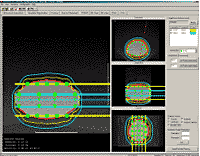
VariSeed Image 1
Real time planning in Implant View gives you the complete dosimetry picture in the procedure room, while there is still time to do something with it!

With VariSeed's O/R-approved laptop configuration, treatment planning and implementation can take place the same day, minimizing costs associated with a traditional surgical procedure. Performed on an outpatient basis, patients may resume normal activity in two or three days.

Configured to support all popular treatment protocols, VariSeed has evolved with the demands of practitioners to become the standard treatment planning system against which all others are measured. With more than 500 VariSeed systems in use throughout the world, VariSeed is a prostate brachytherapy system you can trust to meet your needs, now and in the future.

Using the most recent diagnostic advances to help optimize treatment planning, the newest version of VariSeed offers features designed to overcome the technical difficulties and long learning curves associated with the protocol.


Enhanced VariSeed 8.5: Optimized for Real Time Planning and Image Guided Therapy
Developing the VariSeed treatment planning system made Varian Medical Systems the leader in permanent seed implant brachytherapy. A good thing just got better. Varian's newest version of VariSeed is designed to address the challenges faced in the operating room, pre- and post-plan. You'll know exactly how you are doing, while you still have the opportunity to make necessary adjustments.

Brachytherapy for prostate cancer patients has grown steadily over the years, becoming the treatment of choice of many professionals and their patients. Currently, there are more than 60,000 permanent seed prostate implant procedures performed every year. More than 1,000 physicians and their patients are opting for this method because of its precision, time and cost effectiveness, and reduced side effects such as incontinence and impotence. Varian Medical Systems works together with more than 500 practitioners in the field, continually developing the best brachytherapy product available.

New Standard Features
VariSeed 7.2 is designed to address the challenges faced in the operating room in a true, real time environment. Varian has worked to shorten the learning curves by walking you clearly through the treatment planning process.

VariSeed 7.2 offers the following standard features:

  •  Perform dynamic interpolation of structures on all slices of manually entered contours, as well as outlines between edited contours.
  •  Ultrasound image outlines can be captured automatically, from a solid outline.
  •  Contours may be edited point by point (expand/contract/rotate/move).
  •  Expand contours uniformly or variably by axis to define a new 3D structure from an existing structure. This is especially helpful for prostate volume studies.
  •  Enter points or lines to be projected over the entire data set.
  •  Improved template registration tool to support dynamic grid relocation and bi-directional scaling.
  •  Volume editing enhancements allow you to insert, delete, or edit slices in a volume.
  •  For combination plans, a DICOM RT format for exporting seed plans to an external beam planning system, such as Varian Medical Systems' new Eclipse. This meets the requirements for RTOG trials.
  •  Export source location data to automate needle loading devices, or transfer data to a spreadsheet for analysis.
  •  The Nomogram Editor, a popular option for creating semi-automated pre-plans, is now a standard feature.
  •  A new "shadow" cursor feature puts a marker on adjacent slices when you are entering a seed pre- or post-plan.

Implant View Option
This new, optional feature provides a live ultrasound window on which pre-plan needles and dose distributions can be super-imposed, and displays a 3D orthogonal view of the pre-plan, with the dose distribution superimposed.

Interface to Stepper – VariSeed 7.2 automatically determines the rotational angle and depth of the probe. Once you have registered the longitudinal view to the pre-plan prostate outline, rotate the probe to find a needle being inserted. Identify the needle from the pre-plan transverse view and relocate it to its actual position on the live view. It may be relocated if it does not conform to the pre-plan. This module provides an interface to new generation steppers, such as the AccuCARE Micro-Touch EXII and AccuSeed DS models.
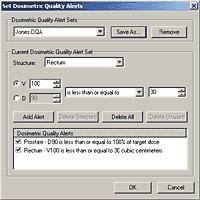
VariSeed Image 2Real Time Dose Updates: As the needle is located in the pre-plan view, you can update the position from the live ultrasound view. Seeds may be located in the needle or as they are dropped. As seeds are implanted, the dose distribution is automatically updated.

Dosimetry Alerts: The Implant View module includes dosimetry alerts that respond if critical dose parameters have been reached. You can respond immediately to the situation, while the patient is still on the operating table.

Real Time Dose Analysis: You are free to perform dose quality analysis--isodose and DVH or CVA, or cold spot identification--right in the operating room.

Image Fusion Module Option
This new co-registration module offers the following cutting-edge techniques:

Co-register 3D data sets: Use a least-squares algorithm, or manual matching by moving one volume set through another. The transparency of each set is operator-adjusted.

Contour definition: You can fuse a CT data set to an ultrasound study.

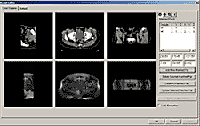
VariSeed Image 3
Fusion of two 3D data sets allows more precise target definition, and therapies that target disease hot spots.

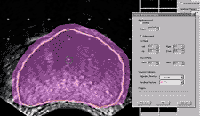
VariSeed Image 5

Dose review: Your plan can be defined on one data set, and reviewed on another.

Functional image guided therapy: Studies have shown that functional images created using Single Photon Emission Computer Tomography (SPECT) and MRI can help clinicians distinguish cancerous regions from normal tissue. VariSeed 8.5 utilizes this technology so disease "hot spots" can be identified and fused to an ultrasound study to ensure superior disease treatment.

For a PDF version of the VariSeed brochure, please click here.

For an Acrobat Reader to read the pdf file please click on the adjacent Acrobat logo       

------------------------------------------------------------------------------------------------------------------------------------------


Interplant Treatment Planning Software

Bringing New Vision to Prostate Brachytherapy
 

A complete collection of essential tools for effective treatment planning, all designed to save time and increase accuracy.


Advanced Planning Tools for custom, user-defined source loading configurations and treatment designs.


Plan Generator dramatically reduces time needed to create a useable treatment plan while permitting radiation dose reductions without sacrificing disease control. Determine the target volume and calculate 3D dose plan in less than 10 seconds. Select from multiple patterns of needle and seed placement


3D Simulation View of prostate, urethra, and rectal anatomies with locations of seed and 3D translucent isodose distribution. Any image slice, needle, or seed may be selected for editing or dosimetry modifications.
Post-Implant Analysis
Interplant Post-Implant Analysis Software is a Quality Assurance tool to examine completed implants and provide post-implant dosimetry confirmation.                                                                                          

The Seed Finder provides true geometry-based 3D volume seed localization, which eliminates redundancy checks, saves time and won't mistake calcifications for seeds.

  •  View seed locations registered with dose calculations, anatomy, DVH, DRR and DRU
  •  3D images can be viewed from any orthogonal or oblique viewing angle
  •  Fully compatible with Dicom 3.0 image files
  •  Windowing, leveling and histogram equalization functions provided on all image views


System Configurations and Options

Point of Care (P.O.C.) Cart is a convenient, plug-and-play solution for today's implant program.

Port Replicator provides a fast, easy connection for the laptop to the monitor, printer and digital stepper.

The on-board flat-screen monitor swivels into sight of surgical field as a single source to view live ultrasound integrated with the planning software during treatment deliver, as the physicist continues to make plan adjustments based on real-time seed placement on the laptop.

Additional features include high quality ink jet printer and a single power supply for all components including the digital stepper. There's even a storage tray for accessories!


                       Point of Care (P.O.C.) Cart

If you are interested in any of the products mentioned here, please complete a Quotation Request Form  or an

Enquiry Form so that we may promptly respond to your detailed request.


TOP OF PAGE

Please contact Colin Walters at cwalters@seedos.com if you would like further  information or you have questions

or comments about this web site.
SeeDOS Ltd, 26, The Maltings, Leighton Buzzard, Bedfordshire LU7 4BS, United Kingdom
Tel: +44 1525 850 670  • Fax: +44 1525 850 685

Please contact SeeDOS Ltd Enquiries at enquiries@seedos.com if you would like further product or service information, a quotation or you have questions

or comments about this web site.
SeeDOS Ltd, 26, The Maltings, Leighton Buzzard, Bedfordshire LU7 4BS, United Kingdom
Tel: +44 1525 850 670  • Fax: +44 1525 850 685


SeeDOS Ltd
Radiation Oncology Equipment and Services
Colin S Walters Copyright 2002
Last Modified : 02/17/12 09:48 AM